Gin Rummy Stars - Card Game
- 4.9
- Rating
- 10.00M
- Installs
- Free
- Price

 Analysis by App-foxy
I came away from Gin Rummy Stars feeling that its biggest strength is focus. This is a free multiplayer card game built around Gin Rummy, not a large collection of unrelated modes competing for attention. I can open it when I have a few minutes, settle into a match, and concentrate on reading the discard pile, managing my hand, and deciding when to knock. That simple loop gives the game a pleasantly familiar mood, especially when I want something more thoughtful than a fast arcade title but less demanding than a long strategy game.
The game is made by Beach Bum Ltd. and is available for Android devices running Android 7.0 or later. It has reached more than five million installs and holds a 4.9 average from roughly 360 thousand ratings, which suggests that the basic experience has connected with a large audience. I would not treat those figures as a guarantee that every player will enjoy it, because card-game preferences are personal, but they do reflect a well-established audience rather than an obscure experiment.
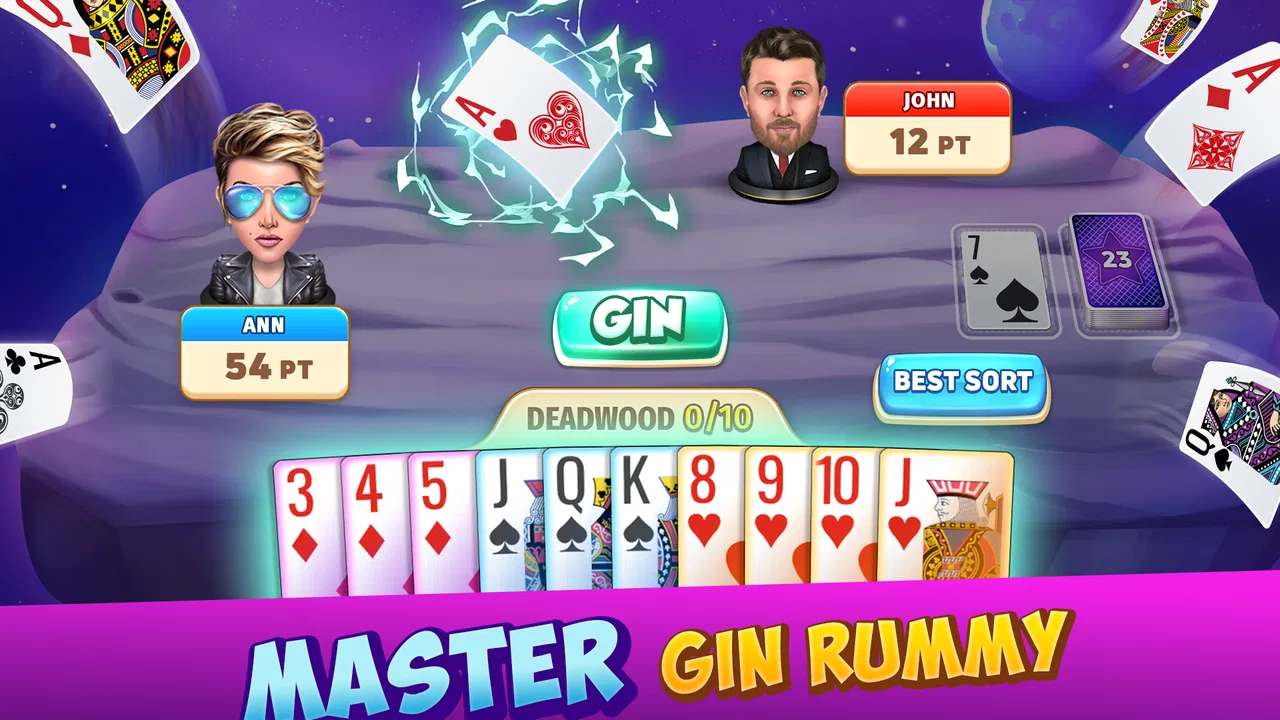
A relaxed card table with a clear visual identity
I found the game’s visual style works best as a quiet invitation rather than a distraction: it gives the digital table some character while leaving the cards easy to follow. That balance matters when a round turns on a quick glance at what has been discarded. It also sets up the next question: whether the presentation supports the decisions that make Gin Rummy engaging.
You May Also Like

 Blood Strike: 2.5 Anniversary
Blood Strike’s Loadouts Turn Every Drop Into a Tactical Gamble
A close look at Blood Strike’s custom loadouts: how fast access to signature weapons reshapes its battle royale rhythm, rewards preparation, and narrows the gap between fights.

 Pandora - Music & Podcasts
Pandora’s Music Is Easy to Start, but Harder to Recover
Pandora’s strength is its low-effort path from a seed to a station. Its weak spot is how much confidence it asks you to place in connection, setup, and quiet recovery.

 8 Ball Pool
 Is Built on Rivalries, Rematches, and Routine
A close look at the rivalries, rematches, shared routines, and unanswered safety questions that turn a quick pool match into a persistent mobile community.

 Samsung Music
’s Quiet Strength Is Playing What You Already Own
Its reach comes less from spectacle than from dependable access to a personal library. That simplicity is both the app’s strongest retention engine and its ceiling.

 AccuWeather: Weather Radar
AccuWeather Review: A Quick, Clear Forecast for Everyday Decisions
For everyday plans, the best forecast is the one you can understand quickly. AccuWeather makes rain timing, radar, and local conditions easy to act on, with a few trade-offs.

 Hill Climb Racing
Why Hill Climb Racing Still Turns Crashes Into One More Run
A tiny car, a bumpy hill and one more upgrade: Hill Climb Racing keeps resurfacing because its simple chaos makes every near-miss feel personal.
More From Our News Desk
View All News


The first few matches establish the right expectations
My first impression was that the game understands why people return to Gin Rummy. The appeal is not flashy action; it is the small tension created by every draw and discard. A useful card can complete a run, improve a set, or tempt me into holding a combination that never arrives. The interface keeps that decision-making visible, so I can spend my attention on the hand instead of searching through menus.
That makes it suitable for a familiar everyday situation: I might have a short break, want to play against another person, and not feel ready to commit to a long session. A single hand gives me a complete little arc. I read the opening cards, adjust my plan as the pile changes, and decide whether my hand is strong enough to end the round. The pacing is more deliberate than a typical casual tap game, but it rarely feels heavy.
The game is rated for Everyone, which fits the accessible rules and straightforward presentation. A newcomer who knows basic card values can begin learning the flow without first understanding a complicated fictional setting or a large collection of characters. At the same time, the familiar rules leave room for improvement. The more I pay attention to what another player picks up or refuses, the more the match becomes a memory and probability exercise rather than simple luck.
There is also a useful distinction between learning Gin Rummy and mastering an opponent. The app can make the first part approachable, but it cannot remove the uncertainty that makes the game interesting. I still have to recognize when a promising hand is becoming too narrow, and I have to judge whether keeping a nearly complete run is worth the deadwood it creates. That balance gives the short matches more substance than the cheerful presentation initially suggests.
The table, cards, and setting work as one mood
The visual direction supports a social card-table feeling rather than trying to turn the game into an elaborate adventure. Cards occupy the center of attention, while the surrounding presentation gives the match a more polished identity than a plain digital deck. I found that helpful because the setting feels intentional without distracting from the information I need: my hand, the discard choices, and the changing state of the round.
This is an important design choice for a game in this category. Card apps can easily become sterile, with a bare table and functional buttons that make every session feel like a spreadsheet. Here, the art direction adds warmth and personality around the rules. It encourages me to treat each match as a small social occasion, even when I am playing from a quiet room and not speaking with anyone.
The presentation also keeps the game from feeling too serious. A mistake does not feel like a dramatic failure; it feels like a bad read that I can learn from in the next hand. That tone is useful for players who enjoy competition but do not want a stressful ranked-game atmosphere every time they open an app. The visual language says that the match matters, but it is still meant to be enjoyable.
One trade-off is that players who prefer a completely traditional, no-frills Gin Rummy table may find the personality unnecessary. If your ideal experience is a neutral deck, minimal decoration, and nothing between you and the rules, this may feel more dressed up than you need. I personally think the extra presentation helps the game stand apart, but it is not automatically an advantage for every card player.
Sound and pacing give short sessions a gentle rhythm
The sound design is most effective when it stays in the background. Card games need feedback, but they do not need a soundtrack that constantly demands attention. The small audio cues around actions help make the table feel responsive, while the overall mood remains calm enough for a quick session. I can play while relaxing without feeling that the game is trying to overwhelm me with noise.
That restraint matches the pace of Gin Rummy itself. The game alternates between quiet evaluation and brief moments of commitment: drawing, discarding, arranging a hand, or ending a round. The rhythm gives me time to think, but not so much that the match loses momentum. A good opponent can make that pause feel meaningful because I am not only calculating my own hand; I am also interpreting the choices appearing in front of me.
I would still recommend checking how the audio fits your surroundings before settling into longer play. A card game is often used in public spaces, during a commute, or late at night, and the visual feedback is important enough that the experience can remain usable when sound is turned down. The game’s appeal does not depend on listening closely to every moment, which is a practical strength for mobile play.
The pacing also affects how I approach risk. In a very fast card app, I might discard quickly and rely on instinct. Here, the calmer rhythm gives me a chance to reconsider whether I am collecting too many possibilities at once. One of my more useful habits is to choose a clear plan early, then abandon it when the discard pile shows that another player is likely waiting for the same cards. That small pause between turns makes the game better for practicing observation.
The mechanics reward attention more than constant speed
At its core, this is a multiplayer Gin Rummy experience, so the strongest reason to play is the interaction between hand-building and opponent-reading. I am not simply trying to create combinations from random cards. I am deciding which information to reveal through my discards, which cards are safe to release, and how long to hold an awkward card while waiting for a better arrangement.
A concrete tip that improved my play was to stop judging a card only by whether it fits my current hand. A discard can also tell the other player what I am not pursuing. If I repeatedly release cards from one area while protecting another, I may accidentally make my plan obvious. I now try to consider the information each discard gives away, especially when the opponent has already picked up something close to the card I am thinking about throwing.
Another useful trade-off involves chasing a nearly finished run. Completing it can reduce deadwood dramatically, but holding several cards for that one outcome can leave the rest of the hand exposed. When the needed card does not appear, I can end up with a hand that looked promising but is actually expensive. The better decision is sometimes to break the attractive combination early and preserve flexible cards. That is the kind of lesson I would not get from a simple store summary.
The multiplayer structure makes these decisions feel different from playing against a static puzzle. Even when the rules remain the same, another person’s habits change the meaning of a discard. Some opponents play cautiously, while others reveal their plans through repeated pickups. I enjoy that uncertainty because it prevents the game from becoming a fixed sequence that I can solve once and repeat forever.
At the same time, Gin Rummy Stars is not the best choice if I want a broad card-game collection in one app. Someone looking for solitaire variations, trick-taking games, deck construction, or a deep single-player campaign would be better served by a larger card suite. This game’s identity is narrower and clearer: it wants me to keep returning to Gin Rummy, improve my decisions, and enjoy the social tension of another player.
Progression and spending deserve a careful look
The game is free to download and play, which makes it easy to test without committing money first. There are in-app purchases ranging from $0.99 to $379.99 per item, so I would approach the store carefully and set a spending limit before handing the phone to a child or letting a curious family member explore. The Everyone rating describes the content, but it does not remove the need for ordinary purchase awareness.
For me, the right way to evaluate the game is to ask whether the basic Gin Rummy loop is enjoyable before considering any optional spending. If the core matches already feel satisfying, the app can work as a casual card table without becoming a purchase-driven hobby. If I only enjoy it when I am chasing extras or trying to move faster through progression, that is a sign that it may not be the right fit for my habits.
This is also where it differs from a physical deck. A real deck has no account progression, digital presentation, or purchase prompts, and it works with anyone sitting at the same table. The app’s advantage is convenience: I can find a multiplayer match without arranging a meeting or carrying cards. The trade-off is that the digital environment may include more distractions and spending decisions than a traditional deck.
Players who want to practice quietly should think about what kind of opponent experience they prefer. The game is designed around multiplayer Gin Rummy, so its appeal grows when I want to react to another person rather than solve a predictable solo challenge. If I am looking for a completely offline pastime for a flight or a place with unreliable connectivity, a physical deck or a dedicated offline card game may be more dependable.
Who will enjoy it, and who should skip it
I would recommend this game to someone who already likes Gin Rummy and wants a convenient way to play on a phone. It is also a good entry point for a friend who understands ordinary playing cards but has never developed a serious strategy for the game. The rules are approachable, while the opponent-reading layer gives experienced players a reason to keep refining their choices.
It works especially well for short breaks, relaxed evening play, and friendly competition that does not require a large time commitment. I can imagine sending it to a friend who enjoys card games but does not want a complex collectible-card system. The focused format makes it easier to return after a few days away because I do not need to relearn a huge collection of mechanics.
I would skip it if I dislike multiplayer uncertainty, if I want a long narrative campaign, or if I find repeated matches too narrow. The same focused design that makes the game easy to pick up can become repetitive for players who need constant new modes. I would also choose a physical deck when the goal is face-to-face conversation, because a phone cannot recreate the social atmosphere of people gathered around the same table.
There is a further distinction between casual and highly competitive players. Casual players may appreciate the friendly mood and compact rounds, while serious card players may eventually want more control over the exact rules, match environment, or opponent selection. I would install it first for the accessible multiplayer experience, not because I expect it to replace every form of organized Gin Rummy.
Practical details before installing
The app was released on January 9, 2020, and the current version is 3.21.14. That gives it the profile of an established mobile game rather than a brand-new launch. The Android requirement of 7.0 or later is modest enough for many older devices, although I would still leave room for the app and its updates so the experience does not suffer from a crowded phone.
Because the title is free, the simplest test is to install it, play enough hands to see whether the turn-by-turn rhythm suits you, and then decide whether it deserves a regular place on your device. I would not judge it from one unlucky match. Gin Rummy naturally includes uncertain draws, and a single poor hand says little about whether I enjoy the decisions over several rounds.
My practical advice is to begin by watching the discard pile instead of trying to build the perfect hand immediately. Keep track of what the opponent takes, notice which cards they release, and avoid holding too many unrelated possibilities. This makes the game more understandable and gives each turn a purpose. It also helps reveal whether you enjoy the central skill: adapting your plan as new information appears.
A coherent atmosphere built around the cards
What stays with me is the way the art, sound, and pacing support the same playable mood. The visual setting makes the digital table feel welcoming, the audio provides gentle confirmation without taking over, and the measured turns leave enough space for thought. None of those elements replaces the mechanics, and that is exactly why they work. They frame the card decisions instead of hiding them.
The result is a game that feels more inviting than a bare-bones Gin Rummy simulator while remaining more focused than a sprawling card-game collection. I like that balance. The atmosphere encourages me to play one hand casually, but the rules reward me when I slow down and study the opponent. That combination gives the game a useful middle ground between relaxation and concentration.
My final recommendation is positive, with a clear condition: install it if you want multiplayer Gin Rummy presented with a polished, friendly table atmosphere. The free entry point makes it easy to try, and the large existing audience shows that it has broad appeal. Just remember to treat the in-app purchase range thoughtfully and choose another option if you need offline play, a wider variety of card games, or a purely physical social experience.
For the right player, Gin Rummy Stars is not about spectacle. It is about making a small card table feel alive on a phone, then giving every discard enough weight to make the next decision interesting. That is a modest goal, but in my experience the game reaches it consistently.
FAQs for Gin Rummy Stars - Card Game
01What is Gin Rummy Stars and how does it differ from other card games?
Gin Rummy Stars is a digital adaptation of the classic card game Gin Rummy, available on both Android and iOS platforms. It differentiates itself with vibrant graphics and engaging animations, making the card game experience more interactive. Players can compete against friends or AI, participate in tournaments, and climb the leaderboards, adding competitive and social elements that are not available in traditional card games.
02Is Gin Rummy Stars free to play, and are there in-app purchases?
Gin Rummy Stars is free to download and play, which makes it accessible to a wide audience. However, it does offer in-app purchases that allow players to buy coins, tokens, or special items that can enhance gameplay. These purchases are optional, but they can provide advantages such as unlocking advanced features or obtaining cosmetic upgrades.
03What are the system requirements for Gin Rummy Stars on mobile devices?
To run Gin Rummy Stars smoothly, Android devices should have at least Android 5.0 (Lollipop) and 2GB of RAM. For iOS devices, it requires iOS 10.0 or later. Having a stable internet connection is also recommended for online play and accessing all features, such as leaderboards and multiplayer modes.
04How does Gin Rummy Stars handle player privacy and data security?
Gin Rummy Stars prioritizes user privacy by adhering to strict data protection standards. The app only collects necessary data to enhance user experience and does not share personal information with third parties without consent. Players can review the privacy policy within the app for detailed insights into data handling practices.
05Can I play Gin Rummy Stars offline, or is an internet connection required?
Gin Rummy Stars offers both offline and online gameplay. Players can enjoy the basic features and play against AI opponents without an internet connection. However, to access multiplayer modes, tournaments, and social features like leaderboards, an internet connection is necessary. This flexibility allows players to enjoy the game anytime, anywhere.
Pros
- Smooth and intuitive user interface.
- Engaging multiplayer mode available.
- Variety of customizable card decks.
- Regular updates with new features.
- Minimal ads
- maintaining gameplay flow.
Cons
- Requires a stable internet connection.
- In-app purchases can be costly.
- Limited offline play options.
- Occasional connectivity issues.
- Some features locked behind paywall.

Gin Rummy Stars - Card Game
Gallery